The Bourne-May Report (2011) was a decisive moment for the British Army’s museum network. Commissioned by the Ministry of Defence (MoD), it examined how regimental museums could remain viable as public funding tightened and the British Army itself continued to evolve. The report introduced the idea of ‘antecedent relevance’, linking financial support to the Army’s future order of battle rather than to its historic regimental structure. In practice, this meant that museums representing amalgamated or disbanded regiments were less likely to receive central funding. It was a pragmatic response to budgetary pressures, but it also marked a shift in how the Army’s history would be curated.
Before the end of the decade, the report’s recommendations had become policy. The number of museums supported by the MoD began to fall, from around 67 to a projected 36. Early closures and mergers followed, as smaller regimental museums found themselves unable to meet the costs of staffing, conservation and maintenance once funding was withdrawn. The 2016 Scoping the Army Museum’s Sector study recognised the public value of these institutions, particularly in terms of education and community engagement, but accepted that they would have to “take their fair share of the cuts”. In 2017 the first group of museums lost their grants, with further reductions to be carried out by 2030.
At the same time, the MoD made clear that it viewed its responsibility as preserving the story of today’s Army, not those of the past. This distinction left a gap that others have tried to fill. Writing for the Museums Journal in early-2012, Richard Smith (Director of the Tank Museum until 2023) identified that military museums would increasingly need to work in partnership with local collections to tell the stories of places and people as well as regiments. That prediction has largely been borne out. Several museums have since moved into shared premises with civic or county museums, while others have transferred ownership to charitable trusts. Those that chose to go it alone have relied on volunteers, veterans’ associations and local supporters to stay open.
As 2025 comes to a close, the wider museum landscape is under strain. The Annual Museum Survey 2025 reports that three-in-five small museums and galleries in the UK fear closure, with income from admissions and grants falling across the board. The findings echo research published earlier in the year by The Art Newspaper, which noted that many institutions are rethinking how and what they display, especially when dealing with difficult or contested histories. For independent regimental museums, these challenges are compounded by the costs of caring for extensive collections of medals, uniforms and documents that require specialist conditions.
Yet there are reasons for cautious optimism. A number of former regimental museums have found new life as independent heritage charities. By broadening their narratives to include local connections, family histories and the experiences of service after the battlefield, they have attracted audiences who might not otherwise have visited. Such ventures have also given them the freedom to experiment with digital interpretation, community-led exhibitions and collaborative research projects.
Now, 14 years after the Bourne-May Report, the sector it reshaped continues to adapt. The old model of a regimental museum sustained by public funding has largely disappeared, replaced by either large modern corps museums or smaller, more flexible organisations with a local focus. Their success will depend not solely on their antecedent relevance but on their ability to remain relevant to the communities they serve today. For those willing and able to evolve, independence may yet prove to be their greatest opportunity to thrive.
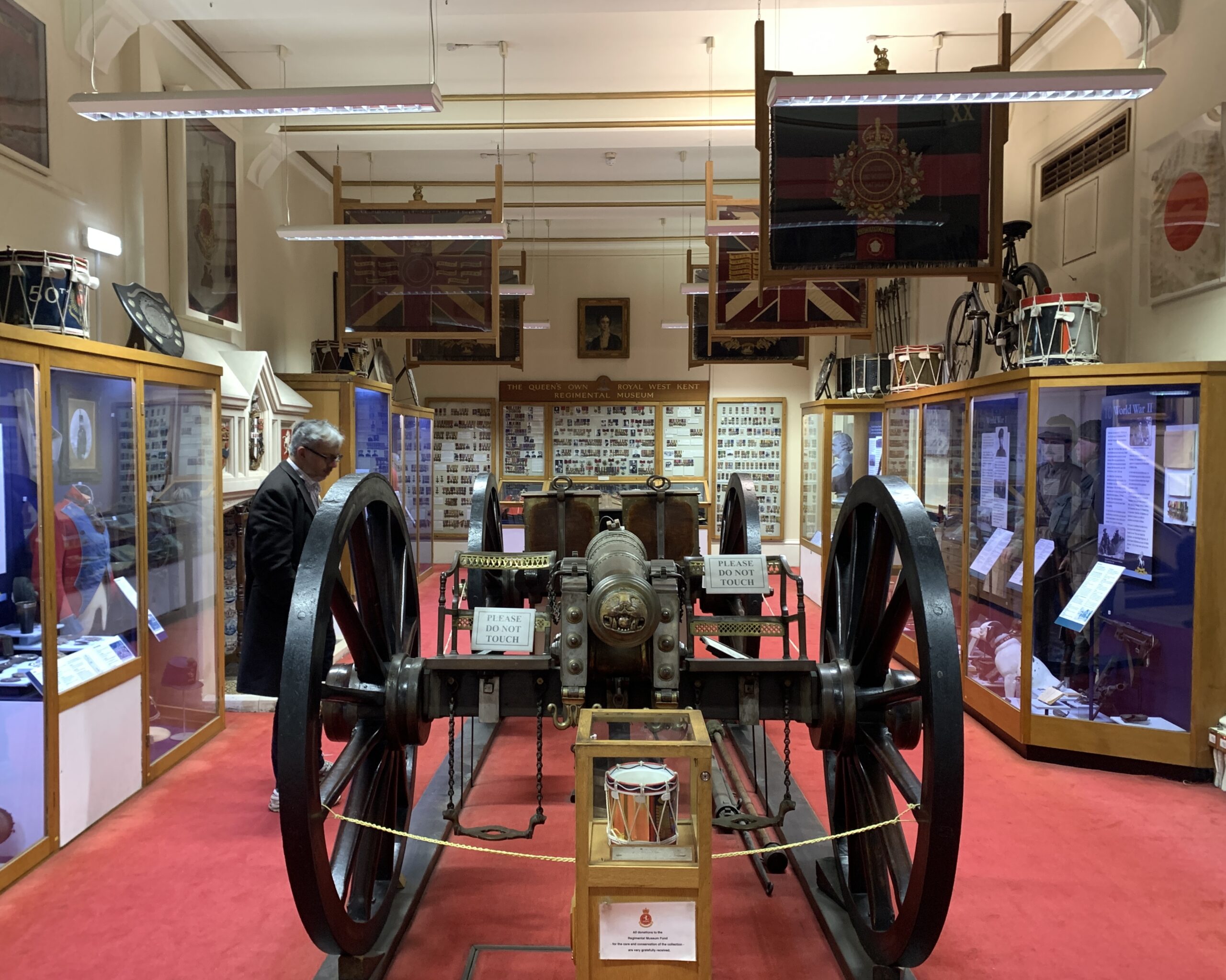
Image: Queen’s Own Royal West Kent Regimental Museum, Maidstone Museum
Sources
Army museums face closure (05-Nov-11)
Military museums have to work in partnership (03-Jan-12)
Scoping the Army Museum’s Sector (Mar-16)
MoD Cuts Funding To British Army Museums (09-Jan-17)
https://www.forcesnews.com/services/army/mod-cuts-funding-british-army-museums
Regimental museums prepare for Ministry of Defence cuts (11-Jan-17)
We Will Remember Them (Won’t We?): The UK’s Military Museums (11-Aug-21)
Three in five small UK museums and galleries fear closure amid declining revenue, new research suggests (21-Feb-25)
Annual Museum Survey 2025 – England Reporting
https://southwestmuseums.org.uk/what-we-do/ams/england-reporting/
Army Museum’s Ogilby Trust (AMOT) ‘Regimental Succession of Titles’ resources